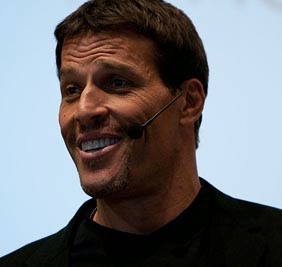
Showing posts with label Tony Robbins. Show all posts

Monday, February 10, 2014

Your Speaking Secret Weapon: Pure Energy


Awhile back, I heard a quote out of the mouth of 2000 World Champion Public Speaking Ed Tate's mouth that essentially said: "When two people meet in a sales or competitive situation, the person with the most energy wins."

I didn't really like that idea. 
I'm usually a little understated when I speak, and when I think of energetic speakers, I think of speakers who feel that being loud and manic is enough to get their point across, and their products/services sold. Tony Robbins, as much as I love listening to him, would probably drive me nuts if I was in one his three day seminars.

In fact, it seems seminars from many of the gurus out there get there audiences into an energetic, even frenzied state with music, videos, even live acts before they come out to give their presentation.

I'm a bit of an introvert, and getting up and dancing and clapping just doesn't tend to appeal to me - and it may not to you, either.

But - it's working for Robbins, Brendan Burchard, James Malinchak, and countless other - which mean I'm clearly in the minority with my thinking.

I'm not going to suggest you need to change who you are to succeed. Wayne Dyer seems calm enough, and he's doing okay. But more energy onstage, when controlled and intentional, can add some great things to your presentation, and create strong results in much of your audience.

1. Speed Up Your Pace - if you're pumped full of energy, you'll likely talk faster. If there's one thing I've noticed with a lot of the more successful speakers, they seem to speak at a higher rate of speed than the average human. They still pause - at least the good ones do - but they always have a bit of urgency in their voice.

2. Implies Passion - more energy will cue your audience's thinking that you really believe what you're saying. That's pretty important. You still need to make it important to them, ultimately, but if they don't believe it is to you, you're not going to move them off center.

3. Enhances Entertainment - would you rather watch a calm, lifeless speaker, or one who really seems jazzed and enthusiastic? The real concern is balance. You may need more energy for 300 than 30 - know what will work in the room, with the audience.

4. Memorability - In a sea of other speakers, if you're at a conference, Ed's idea rings true. He's the only speaker I remember from that event - though I heard there was at least one other that 'rocked the house', I just didn't attend their session.

How can TOO much energy hurt you?

1. Madman On Stage - that might be the impression that you leave if you spend your entire presentation at a 10, instead of calming down and conversing with the audience.

2. Forgetfulness - have you ever gotten so excited that you completely blank on what you want to say? It's called getting caught up in the moment, and in this case, perhaps getting too caught up in your own energy.

3. Perspiration - it's great that you like to dance and move around the stage a lot - unless you start to look like someone working out during the first week of the Biggest Loser workouts. I'm a 'sweater' even in my understated style - can't imagine what would happen if I started dancing...

4. Fatigue - starting at a high and staying there could mean ending on a low, if you're speaking for a long time, or if you're not as healthy or dedicated to healthy eating as you'd should be.

Also consider your purpose for being energetic. Are you wanting to drive home a point? Are you wanting to significantly alter the state of your audience? If so, is it so their behavior changes for the positive, or to create a more selfish behavior, like a back of the room rush?

Don't misunderstand me - getting people excited isn't inherently a bad thing. They better be enthusiastic when you're done speaking to them. But using energy as a manipulation technique that doesn't directly benefit them IS a bad thing, at least in my eyes. There's room for argument here - what's too much? what's direct benefit? But I think most of us who've seen these speakers whip a room into a frenzy, assuming we weren't swept along, would know it when we see it.

Pure Energy can be your secret weapon, if you learn to harness it, and release it appropriately. Too little, and you're lucky if your audience knows who you are the next day. Too much, and they'll all remember you, for all the wrong reasons. Of course, you can't control everyone, so be ready for there always to be people who think you are TOO pumped up, or TOO understated.

Experiment (in a Toastmasters club, preferably, where you'll get a generally supportive, non-judgmental audience) with your energy levels. See what the reactions are. Gauge what YOU are comfortable doing. While I didn't really like the idea back then, I have to admit it's true in more cases than not. I'll be ramping up my own energy this year.

But worry not - I won't be dancing!

Sunday, December 29, 2013

How to Speak & Offend Part III of IV: How to Speak & Offend Your Fellow Toastmasters - and Soon the World

In Part I, I gave some tips to avoiding offending your audience inadvertantly. In Part II, I suggested that offending the audience is actually our job as a speaker. A few people mentioned that we should be able to speak about 'offensive' topics - and wondered where they might test their material.

Toastmasters - the worldwide non-profit dedicated to helping people develop public speaking and leadership skills - is the perfect place to be offensive. It's also a great place to learn NOT to be, and, believe it or not, an ideal place to deliberately BE offensive, in preparation to offend the world.

Now, before you go off and join a club with the intent of riling everyone up with your latest Duck Dynasty rant, take a look at the list below.

1. Know Your Club - much like my oft=repeated mantra - Know Your Audience. Every TM club around the world, despite following the same basic educational program at their core, is different. You will find a corporate club - say the one that meets at lunch on the sixth floor in your company tower - to be significantly different in makeup and manner than a local community club meeting at your library.

What those differences are isn't easily predicted - they may actually be MORE able to handle touchy topics than said community club. Some clubs meet at churches or other public venues that might hamper the discussion of certain topics. But the most important aspect isn't the location - it's the people IN the club. Are they open to topics that may push the envelope on taste and appropriateness? Even that statement is up for interpretation. Bringing up the word sex, or discussing liberal vs. conservative ideals in one club might be enough to shake them to their core, or be so passe that you better go further just to be heard above the noise.

Visit a club for a few weeks to get an idea of their personal club standards. Talk to the VP of Education. If you're new - give yourself a speech or two before going for the jugular with your assessment of your current world leader you've deemed to be the anti-Christ.

2. Turn Your Audience Into Actors. One interesting aspect of Toastmasters is that it is specifically designed to be a supportive group for you to improve your skills. One way of taking full advantage of that is by telling your audience who they need to be for your speech. In your introduction, or perhaps as an objective read by your evaluator BEFORE you give your speech, mention that your audience is a group of women looking to enforce their rights to breastfeed in public, or a meeting of the National Meatcutters Association, or a group of freshmen college students attending a meeting on Safe Sex.

This gives the audience a bit of notice, so that you don't totally jar them unnecessarily, and improves your chances for helpful feedback vs. an outraged response. They can listen to you with the ears of your desired target listener, and do a better job evaluating your delivery method without being so bothered by the nature of your content.

3. Expand & Advance - to an Advanced Club. Once you've determined the clubs parameters on subject matter you can decide, at your own risk, whether to try to push a bit in that club environment or go elsewhere. That doesn't mean going outside Toastmasters. Advanced clubs often have a higher tolerance for off-color, controversial, or more-spirited topics. Some actually specialize in it. Ask around, check the website, and make some visits. You'll usually need to stay in your regular club as a membership-requirement for an Advanced Club, but even two clubs a year is peanuts compared to most public speaking training available.


4. Organize a 'No-Holds-Barred' Meeting. Many clubs have a variety of special meetings throughout the year, from Backward Meetings to Holiday themes - why not create a meeting specifically geared to tough topics, publicize it (heck, wouldn't your local paper love to hear about a group of citizens talking about everything from gay marriage to legalized marijuana to suspending kindergartners who kiss their fellow classmates?), and give everyone a chance to be prepared, and, of course, to participate. Be sure to explain it fully at the beginning of the night, in case you have guests. And let people know if they would rather have that night off, it's completely understood.

5. Record & Judge Thyself. Are you really saying what you want to say? Is your stage demeanor what you expected? Are your word choices intentional? Separating yourself from the speech, getting outside of yourself and your passion will help you become more objective as you continue to build your message. Share it with a few trusted friends and/or a presentations coach.

6. Let Your Audience Change You. The previous four methods all focus on gauging and managing your Toastmasters audience, to help them help you help others. Keep in mind, however, that you will run into everyday people in your real-life audiences who will be offended as well, no matter your venue. Bring an eval form for everyone in the room and find out which notes you're hitting well and which are off-key, and ask them to sign their forms so you can evaluate for yourself whether their feedback will work for you. You might find the perfect way to soften a statement or tone, or you might even discover you aren't as controversial as you think you are.

If you've found other strategies, or know of an Advanced Club in your area that can offer an open audience for broader topics - please share in the comments below, or on Speak & Deliver's Facebook Page.

Offend with Intention. I mentioned this in Part I, but it bears repeating. As a Speak & Deliver reader, I'm confident you truly care about your message and what your audience gets out of it. This makes learning to be 'offensive' in the most optimal manner crucial. Being crass or inappropriate for crassness and inappropriateness' sake will not help you, your audience, or your cause. Even Tony Robbins, often the crassest of the crass, swears and offends with intention - his belief is that if you can't handle the language, you're in the wrong audience, and he's actually trying to get your to leave. For many people I know, he is considered to be a terrible example as a speaker - people often tell me how much they hate him. But, just as often, I hear from people who absolutely love him - and he's built quite a career offending with purpose, whether we agree with his purposes or not.

If your audience hasn't moved toward your message by the time you finish, you've failed. Sometimes it takes a little push, sometimes a big one. Knowing the difference is knowing how to Speak...& Deliver.

Tuesday, December 17, 2013

How to Speak & Offend: Part I


I get questions, every now and again. Today I'll tackle a recent favorite:

"How do I avoid offending my audience?"

Aside from the obvious answers, like showering, using deoderent, making sure your zipper is up or your blouse is buttoned to a level of decency, and not being, as a general rule, an insufferable jerk, I have some ideas.

1. Avoid SPR - Sex, Politics & Religion. If your topic isn't speaking about one of these directly, bringing it in as part of a story or a 'humorous' aside, can be risky. I recently spoke in Toronto. Easiest punchline all weekend was their crack-smoking mess of a mayor. For THEM. I went into my 12 day trip up there with the clear intention of not even mentioning it unless it was mentioned to me. When it did come up, I'd smile and nod. When asked a direct question, my stock answer was 'America's just happy there's a politician screwing up somewhere else'.

2. Don't Accuse - We are told as speakers to involve our audience, to watch our I/You ratio - but it can be easy to sound like we're accusing our audience of falling short, being unintelligent, and just plain not as good as us, the magnificent speaker. We don't mean this, of course. Well, hopefully. Asking people to think about what they would do, to imagine themselves in a situation, or if they've ever seen someone act a certain way, is a far better approach. Referring to 'Mr. X' from your own experience, or even making up a character to embody the negative behavior can also be effective. There will be a time to challenge the audience directly, but even then, you should be challenging them to do something positive to reach a result, vs. stopping behavior you don't even know if they are doing.

3. Beware Spontaneous Humor - This is a tricky one, because I am also in strong support of spontaneous humor. It can often create some great laugh lines, when you're on track with the audience. It can also put you in a tough spot with some if you aren't careful. I recently took part in a Q&A with World Champion of Public Speaking Randy Harvey up in Toronto, and, in talking about fluff speeches, mentioned they were 'like Chinese food - always leaving you hungry an hour later'. Innocuous enough, right? And an expression I commonly use. Unfortunately, we had just had Chinese food as the buffet meal that night, and the audience response was one of shock, which would have turned into offense quickly had I not immediately addressed the head of the meeting with my next comment, acknowledging the potential offense I had created. I stayed in a humorous tone, and the moment passed. But I'm sure some were still offended, and for all I know, I also offended a Chinese person or two in attendance. Beware might sound like a strong term - but it's really short for Be Aware - and that's important at all times.

4. Know Your Audience - do a little research by talking with the meeting planner and others in the company/group to find out what is off-limits to your audience. Maybe they've had layoffs recently. Perhaps they've had staff in an accident - for instance, a speaker friend of mine who often uses airplane humor talks about a client whose CEO had just died in a plane crash. Had he not done his homework, he would have put himself in a tough situation. What are your clients taboo topics, and taboo humor?

5. Dress the Part - I jokingly referred to zippers and blouses at the open, but not dressing to the right level of appropriateness can be a real turn-off to your audience. Unless part of your identity is flannel shirts and cowboy boots, and the people who hired you know it, I don't advise showing up in that combination in front of a corporate audience. Inspired by Steve Jobs years ago, I once wore slacks, a black turtleneck, and a nice suit-jacket to give a keynote. Afterwords I had several people take me aside and tell me they were offended I hadn't worn a suit that morning. Clearly I was not Steve Jobs. And I hadn't focused enough on #4 - Knowing My Audience so I'd know what was appropriate. In addition to types of clothes, watch the shoes you wear, the jewelry you choose, the makeup you wear, and any fragrance you may choose for an event.

6. Blue Language - for those of you younger than 40, 'Blue Language' refers to swearing. As socially acceptable as swearing has become, and as tempting as it is to use it for a quick laugh, it can be a connection and credibility killer. Just as with clothing, if it's part of your identity as a speaker, make sure your audience knows it ahead of time. Even then, know your audience, and to what level you can push. In the annals of Toastmasters, there's a story of Tony Robbins giving his Golden Gavel acceptance speech, and, as he is well- know for doing, used a fair amount of 'Blue Language'. It's part of his schtick - to break his audience out of their thought patterns. A good approach, perhaps, for people who have paid you thousands of dollars to attend your personal event, but a cataclysmic approach for many of the older, conservative Toastmasters in attendance.

------

These may all seem like common-sense tactics, but you'd be surprised how easy it is to lose track of your common sense in the heat of the moment. In other cases, 'You Don't Know What You Don't Know'. And, of course, there's always the thought - 'Well, it'll work for me'. It might. but it might not. Don't say you weren't worned.


As I've alluded to with dress and language, sometimes offending your audience is part of your strategy - and I'll address that in Part II. In the meantime, what offends YOU from the stage? Please share your experiences below - you never know who you'll be helping - to Speak & Deliver!

Monday, June 3, 2013

What I Learned From Ryan Avery: 2012 World Champion of Public Speaking

Ryan is Really Tall - at least compared to me.
'Rich, did you learn anything from Ryan today?'

I was asked this question a couple of times yesterday, and it was difficult for me to answer.

Ryan Avery, at the age of 25, won the Toastmasters World Championship of Public Speaking last August - a title I've chased for the better part of the last 12 years, coming up just short as 2nd Runner Up in 2006, when Mr. Avery was probably just a Sophomore in college....!

Yesterday, on his trek moving himself and his bride, Chelsea, to Texas, he stopped to give a free 2 hour speaking seminar about 'How to Give a Great Speech' to 70 local Toastmasters in an event sponsored by our local District 26.

Ryan was energetic. Funny. Humble. Transparent about his failings. Occasionally kept in-check by his wife and his mother-in-law, as most men are. His presentation was well-organized, had a strong power-point that supported his presentation without overwhelming it, and he supported his information with personal examples that kept our attention and interest.

'Rich, did you learn anything from Ryan today?'

No. And Yes. 

No.

I've been studying speaking methods in one way or another, through Toastmasters, through sales training, through drama, and through my own personal passion for the subject for the last 32 years. Ryan and I both had 2004 World Champion Randy Harvey as coaches, so even that homespun advice was old hat. Even his wonderful motivational review of Simon Sinek's 'What - How -Why' model was familiar to me through the teachings of many other speakers I've followed, most specifically John DiLemme's 'What's Your Why?' programs.

And Yes.

First, hearing all this information in such a compressed and concise manner helped me refocus on a few things I want to accomplish. Writing in this blog for one. Possibly competing next year, for another.

Second, I learned a lot about HIM - and all the hard work he put into winning the trophy in just his first nine months. He talked about the hundreds of hours he put into practicing. Probably more hours that I have in my 12 years competing combined. Six kids tend to dominate my hours - just saying.

Third, I learned that he has probably learned more about speaking and the speaking business in the nine months SINCE winning than in his journey to winning in the first place. His presentation and product table was as professional as I've seen from most any World Champion.

Fourth, I learned that my concept of Win Anyway is more important than ever. When someone wins a championship, a gold medal, a political office, whatever, on their first try - it colors their perspective. People teach what they know - and Ryan teaches visualization, writing goals down, hard work, positive attitude - all within the scope of achieving his victory. He says he refused to let the thought of losing enter his mind for any length of time. For him, it worked out. For 29,999 other competitors, it did not.

I don't believe for a minute that Ryan thinks that if we all work as hard as he did, if we all follow his track to the WCPS religiously, that we will all win. It's an impossibility. Still, for him, he doesn't know what it's like to lose in that venue - to get so close you can taste it, and then watch another grasp it for themselves.

He was asked what would happen if he lost, and he really had no answer, beyond 'I couldn't have lost'. I think he meant this, at some level, in a 'Win Anyway' kind of way - that by doing his best he couldn't have experienced a loss. He came close to saying this, but always came back to the statement 'I already knew I was the World Champion'.

You don't know what you don't know - and Ryan doesn't know what it's like to lose the World Championship. Tough to fault him on that, right?

Fifth, and most importantly, I learned that sometimes I just don't work hard enough. On my speeches, on my life in general. Maybe this is a lesson more appropriate for my Win Anyway blog, but I learned it both from 2001 World Champ Jim Key a few weeks ago, and Ryan, so here it is.

Yes, I may have six kids. Yes, we may have a tremendous amount of medical stuff going on, from brain tumors to Aspergers to Degenerative Disk Disorder to Scoliosis to Neurofibromatosis. But it doesn't give me a pass to stop working towards my dreams. Not necessarily winning the World Championship, though that would be nice, but of really getting out there with my speaking career, of making a bigger difference than I've been making.

Ryan Avery was and is all about playing big. As much as I've accomplished, as many people as I've had the privilege of helping, I've still been playing small.

'Rich, did you learn anything from Ryan today?'

No. And Yes. No, I didn't learn how to play big from him - I think Tony Robbins taught me that years ago. And Yes. Ryan reminded me that I SHOULD play big, that I CAN play big, and that I am cheating myself, my kids, my clients, my readers, if I don't.

I doubt Ryan intended that to be his message yesterday. Regardless, that's what I learned. Because Ryan Avery can Speak....& Deliver.

'Your playing small does not serve the world. There is nothing enlightened about shrinking so that other people won't feel insecure around you. We are all meant to shine, as children do. We were born to make manifest the glory of God that is within us. It's not just in some of us; it's in everyone. And as we let our own light shine, we unconsciously give other people permission to do the same. As we are liberated from our own fear, our presence automatically liberates others' - Marianne Williamson

Cat Moonlight Red PU Penta Oto Custom ( 100ml,200ml,400ml,500ml,1L )

  cat Moonlight red  menggunakan bahan PU penta oto, mempunyai kelebihan warna lebih terang, awet, daya tutup 2 lapis. gunakan warna dasar h...